How to transcribe a long recording accurately
What accuracy percentages actually measure, where the errors really land, and the three-pass check that finds them without re-listening.
Transcription accuracy figures are measured on clean single-speaker audio and do not predict how a tool performs on your recording. Errors cluster in proper nouns, numbers, short replies and overlapping speech rather than spreading evenly. Improve the recording before the model: separate tracks per speaker, a close microphone, and a vocabulary list of names. Then check the transcript by searching for those names and numbers rather than by reading it through.
The steps
- 1Record a separate track per speaker if you can — Separate tracks remove the overlapping-speech problem entirely. Ask before the call, because most conferencing tools will export per-participant audio.
- 2Get the microphone close — Reverberation costs the largest models about two points of word error rate and the smallest over fifteen. Room acoustics punish cheap models hardest.
- 3Write a vocabulary list before transcribing — Names, companies, products, acronyms. One line of input, and it targets exactly the errors that model scale does not fix.
- 4Split long audio on silence, not on a clock — The OpenAI file endpoint accepts up to 25 MB, which an hour of good audio exceeds. Chunk at pauses so no word is cut in half at a boundary.
- 5Check by searching, not by reading — Search for every name on your list, then for every number. A confidently wrong word reads as correct prose, so reading through will not find it.
What does "99% accurate" actually mean?
Accuracy claims are almost always measured on clean, read, single-speaker audio, which is the easiest material that exists. Whisper large-v3 scores around 2.7% word error rate on LibriSpeech test-clean. That is audiobook recordings: one speaker, close microphone, no interruptions, no crosstalk.
On real meetings, podcasts and phone calls the same model lands nearer 8 to 12%.
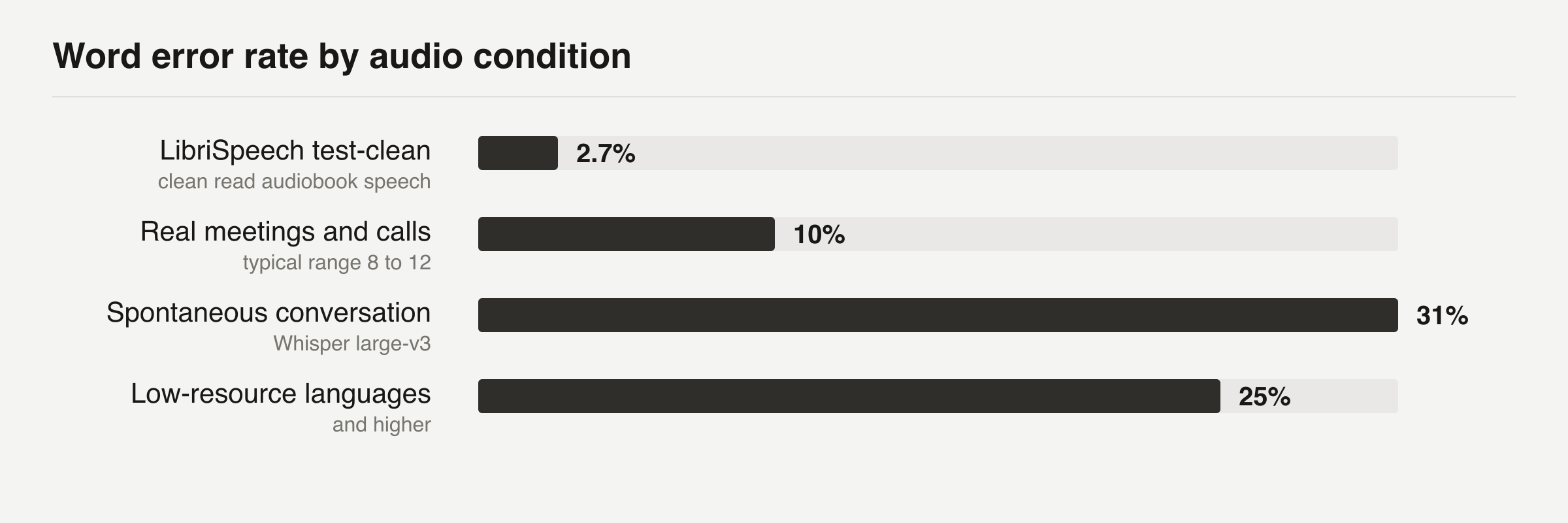
Word error rate counts the proportion of words inserted, deleted or substituted against a reference transcript. A 2.7% figure and a 31% figure can describe the same model on the same afternoon. The only thing that changed is what it was asked to listen to.
The practical consequence is that vendor accuracy numbers cannot rank tools for your use. What separates them is behaviour on the specific things your audio contains, and none of that appears in the headline figure.
Is human transcription the gold standard?
Human transcription is the reference these models are scored against, and the reference turns out to be less stable than it sounds. Careful human transcription of one corpus has been measured at 4.1 to 4.5% error. Quick transcription of the same material came in at 9.6%. Same people, same audio, different amount of care.
It gets less comfortable than that. When four human transcribers produced versions of one recording, the error rates between the humans ranged from 10% to 20%. On the CallHome corpus, the accepted human reference differs by a factor of 1.66 between two competent teams working from identical tape.
A claim of "human parity" is a claim about one transcription protocol, not
about human beings. Two labs measuring the same thing got answers that
differed by more than the gap they were trying to measure.
For a long recording the useful conclusion is blunt. A perfect transcript does not exist to be bought at any price. The realistic goal is a transcript whose errors sit in places you can find, which is a completely different target and a much cheaper one.
Where do the errors actually land?
Errors cluster, and they cluster in the places that matter most for searching and quoting later:
- Proper nouns. A model resolves ordinary English from context and has no context for your colleague's surname, so it substitutes the nearest common word and does it confidently.
- Numbers. Dates, quantities and figures, which are high-value and hard to spot as wrong.
- Short replies. Single-word utterances have the highest error rate of any length, thought to follow from these models being trained on thirty-second chunks.
- Overlapping speech. Two people at once is the condition every benchmark avoids and every real meeting contains.
- Domain jargon. Terms a general model has no reason to have seen.
The short-reply problem deserves more attention than it gets. In a meeting recording the single words are yes, no and agreed, and those are the words decisions hang on. A transcript that is 94% accurate overall can still be wrong about who agreed to what.
Overlap is the other reliable failure, and it is architectural rather than incidental. Whisper does not perform speaker diarization at all. Working out who spoke when is a separate model layered on top, usually pyannote.
Diarization has its own error rate, reported around 11 to 19% on standard benchmarks and worse on audio with heavy overlap or more than four speakers. Those errors compound with transcription errors rather than replacing them.
How do you set up a long recording to transcribe well?
Fix the audio before you touch the model, because no model recovers information the recording never captured.
A separate track per speaker eliminates the overlap problem entirely, and it is the single highest-value change available. Most conferencing tools will export per-participant audio if you ask before the call rather than after. Ten seconds of setup removes the failure mode that costs the most to repair.
Failing that, get the microphone close. Reverberation costs Whisper large-v3 about 2.3 points of word error rate, and costs Whisper tiny over 15 points, so room acoustics punish small models hardest. A lapel or headset microphone at conversational distance beats any amount of post-processing.

Watch the file size limit before starting a long job. OpenAI's file transcription endpoint accepts uploads up to 25 MB, which an hour of good quality audio exceeds comfortably. A long recording therefore has to be compressed or split, and chunking on silence rather than on a fixed clock keeps words from being cut in half at the boundary.
Compression is usually the better answer for speech. Dropping to a 64 kbps mono MP3 costs almost nothing in recognition accuracy, because speech recognition models are not listening to the frequencies that bitrate discards.
Should you give the model a vocabulary list?
Give it one whenever you know the names in advance, which for a meeting or an interview is nearly always. Most transcription APIs accept a prompt or a phrase list, and supplying the proper nouns is the cheapest accuracy improvement available. It costs one line of input and it targets exactly the errors that model scale does not fix.
What belongs on the list:
- People's names, including the ones spelled unusually
- Company and product names
- Acronyms your field uses
- Technical terms a general model would not have seen
- Place names local to the conversation
What does not belong: ordinary vocabulary. A list padded with common words dilutes the signal and makes the useful entries less influential.
Where a tool offers no vocabulary feature, fall back to find and replace over the finished transcript. Less reliable, because a substituted name is not always substituted the same way twice, but it takes minutes and it fixes the errors a reader notices first.
How do you check a transcript you cannot re-listen to entirely?
Check the places errors cluster instead of reading the whole thing. Nobody re-listens to a two-hour recording, and reading the transcript straight through does not work either, because a confidently wrong word reads as perfectly good prose.
Three passes, in increasing cost:
- 1Search for every name on your vocabulary list. A name that never appears was substituted by something else. This takes about a minute and finds the errors most visible to anybody you send the transcript to.
- 2Search for the numbers. Dates, figures, quantities, times. Digits are high-value and frequently wrong, and they are quick to scan.
- 3Spot-listen where confidence is low or speakers overlap. If the tool reports per-segment confidence, sort by it. If it does not, look for very short turns in the diarized output, which is where overlap usually is.
The first two cost almost nothing and catch the errors that embarrass you. The third is the one to skip when the transcript is for your own reference and to run when somebody else will quote from it.
The principle underneath all three is that you check with a different instrument from the one that produced the artifact. Re-reading a transcript uses the same faculty that produced the error in the first place. Searching for a name you already know is genuinely independent, which is the same reason a subtitle file gets watched muted, and the reason every pipeline in our worked examples ends with a measurement rather than a delivery.
Which tool should you use for a long recording?
Pick on three things: whether it does diarization, whether it accepts a vocabulary list, and what happens to files over an hour. Raw accuracy is the axis everybody compares on and the one that separates these least.
The last row is the one that gets skipped and then causes a problem. A recording of an internal meeting is company data, and uploading it to a consumer service with unclear retention is a decision somebody should make deliberately rather than by default. Running a model locally is genuinely practical here, because speech recognition is one of the few tasks where an open model on a laptop is close to the hosted state of the art.
For a one-off recording, use whatever the platform already gives you and spend the saved effort on the checks. For anything recurring, the cost of setting up a vocabulary list and a per-speaker export pays back within about three recordings, because both changes attack the errors that take longest to find.
When is it worth paying a human?
Pay a human when the transcript is evidence, when the audio is bad and cannot be re-recorded, or when the material is legally or medically consequential.
Evidence is the clearest case. A transcript quoted in a document somebody else relies on needs to be right in the places that matter, and the cost of a human pass is small against the cost of being wrong in public. Professional transcription typically runs somewhere between $1 and $3 per audio minute depending on turnaround and accent difficulty.
Bad audio is the second case, and the economics are counterintuitive. Machine transcription of a difficult recording produces a transcript that takes longer to correct than it would have taken to type, because you have to listen to everything anyway to know which parts are wrong. Past roughly 20% word error rate the machine draft stops being a head start.
Everything else is a good fit for a machine draft plus the three checks above. That covers the overwhelming majority of meetings, interviews and podcasts, and it costs a few cents rather than a few hundred pounds.
Questions
What is a good word error rate?
It depends entirely on the audio. Around 2.7% is achievable on clean read speech, 8 to 12% is normal for real meetings and calls, and low-resource languages can exceed 25%. A number quoted without the material it was measured on tells you nothing.
Can these tools tell speakers apart?
Not on their own. Whisper performs no diarization; separating speakers is a second model layered on top, and the standard one reports 11 to 19% diarization error on benchmarks and worse with heavy overlap or more than four speakers.
Is a bigger model always better?
For robustness, largely yes. The reverberation penalty is far smaller on large models. For clean close-miked audio the difference narrows to the point where speed and cost decide it.
Why do short answers get transcribed wrong so often?
Single-word utterances have the highest error rate of any length, thought to follow from training on thirty-second chunks. In a meeting that means the yes, no and agreed, which are the words decisions hang on.
Sources
- Speech to text: file transcription, limits and formats — OpenAI · checked 5 Sep 2026
- Disfluencies and Human Speech Transcription Errors — arXiv · checked 5 Sep 2026
- pyannote.audio: speaker diarization models and benchmarks — pyannote · checked 5 Sep 2026
- Whisper-RIR-Mega: ASR robustness to room acoustics — arXiv · checked 5 Sep 2026
/blog/transcribe-a-long-recording.md — this page, for the agent reading it on your behalf